




Posted:09-October-2026
Golden Corral Buffet Economics and International Expansion Implications
On Monday, September 28th a very detailed article was published on the front page of the Wall Street Journal entitled, “How America’s Biggest Buffet Chain Cracked the Math of All You Can Eat”.
The central conclusion is straightforward: Golden Corral makes the all you can eat model work through traffic density, precise menu engineering, lower front of house labor, disciplined waste control and beverage attachment. The format is not protected by the headline price alone. Its economics depend on managing hundreds of small operating decisions continuously and at scale.
For the first phase of expansion into Mexico, Spain and the United Kingdom, this makes format design and operating capability more important than market size by itself. Each country presents a different balance of achievable pricing, labor expense, occupancy cost and local sourcing. EGS should therefore evaluate the three markets through separate four wall models and use the first flagship in each country to validate traffic, menu mix and waste assumptions before authorizing broader development.
What the Wall Street Journal article establishes
- Dinner pricing generally ranges from $15.99 to $18.99 for unlimited plates, including sirloin. The value proposition is deliberately visible and simple.
- The average buffet carries roughly 150 items. Operators know the cost of producing each item and arrange the line in meal modules that pair higher-cost proteins with lower-cost starches and vegetables.
- The chain uses demand data to determine production in 15-minute increments. Cooking too far ahead lowers quality, increases waste and pushes guests toward other products.
- Approximately 80 percent of buffet items are made in house. This supports quality and flexibility but increases the need for trained production systems and disciplined kitchen management.
- Food costs are approximately 38 percent of sales, above the typical restaurant level. Lower service labor partly compensates because customers serve themselves.
- Management seeks to hold utilities, occupancy and other costs near 10 percent of sales. That target becomes harder in markets with high rents, energy costs or inefficient building formats.
- Traffic is critical. Management indicated that losing 500 diners per week can put a restaurant in difficulty. Some of the busiest units produce about US$7 million in annual sales.
- Beverages are incremental rather than included. Refillable beverages sell for about $3.20, and most guests purchase something other than water, making drink attachment an important margin contributor.
- Waste is an economic signal, not merely a disposal issue. Poorly executed food is discarded and replaced with other food, creating a double cost.
- Golden Corral has introduced a bone-in fried pork chop costing about 40 percent as much as sirloin to redirect some demand without hiding or removing the premium offering.
Reported figures above are drawn from Heather Haddon, “How America’s Biggest Buffet Chain Cracked the Math of All You Can Eat,” The Wall Street Journal, September 26, 2026.
The operating equation
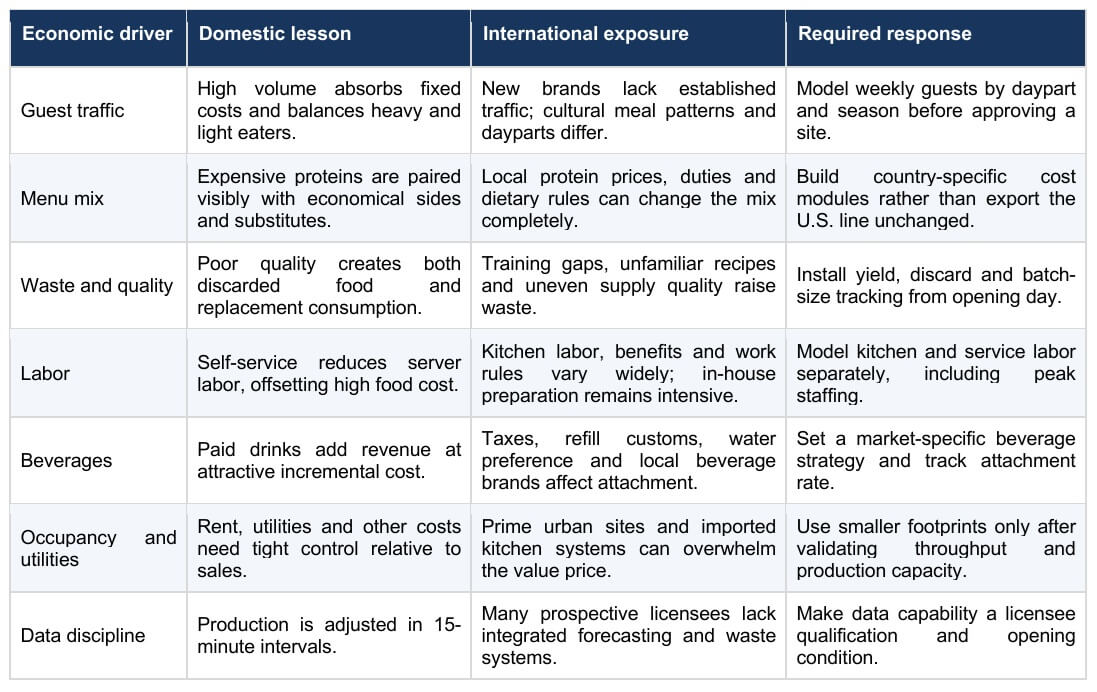
Golden Corral’s economic advantage is a portfolio effect. No individual dish determines profitability. The result comes from the combined relationship among guest count, average check, food mix, waste, labor, beverages and fixed-cost absorption.
Traffic sensitivity in practical terms
The article’s warning about losing 500 diners a week illustrates the scale sensitivity. At the reported dinner price range of $15.99 to $18.99, 500 fewer weekly guests would represent approximately $416,000 to $494,000 of annual meal revenue before beverages. This is an arithmetic illustration, not a Golden Corral forecast, but it shows why site selection and market-entry awareness are decisive.
Implications for the Golden Corral international model
- The proposed smaller format must preserve volume economics - The proposed 7,000-square-foot international model can lower construction, rent and utility requirements relative to the standard 11,000-to-15,000 square-foot format. However, a smaller building does not automatically produce a better business. Reduced seating, narrower buffet capacity and a smaller kitchen can constrain the traffic and batch-production efficiency that make the model work. The first international flagship in a major city may still need a larger format, with smaller units introduced only after local demand, table turns and menu productivity are proven.
- The 150-item U.S. buffet should be treated as a system - The domestic buffet averages about 150 items, but international units should preserve the economic logic rather than copy every item. A smaller format may require a tighter assortment. The menu should retain recognizable Golden Corral anchors while using the agreed adaptation allowance to create local modules that balance protein cost, guest appeal and supply reliability. Any reduction should be tested against the perception of abundance, which is central to the brand promise.
- Local sourcing is fundamental - A buffet exposes a restaurant continuously to commodity prices and currency movement. Beef, poultry, seafood, dairy and produce must be evaluated by landed cost, yield, consistency and regulatory acceptability. Importing too many core items would magnify foreign-exchange and freight exposure. Each market needs approved local equivalents and at least one cost-effective substitute for every premium protein category.
- Licensee capability must extend beyond capital - Golden Corral’s investors will be country licensees, without Golden Corral capital. Financial strength is therefore necessary but insufficient. The operator also needs high volume restaurant experience, centralized procurement, real-time food-cost reporting, production forecasting, food-safety management and the authority to intervene quickly when a unit misses traffic or waste targets. A well capitalized investor without those capabilities represents material execution risk.
First phase market considerations
Country specific priorities
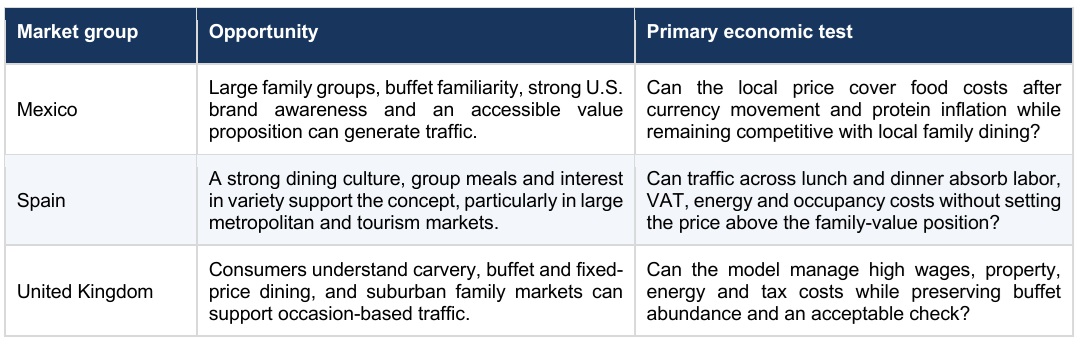
Mexico offers the clearest potential for high family traffic and strong recognition of U.S. restaurant brands. The core challenge is not acceptance of the buffet format but maintaining an accessible check while protecting margin from currency movement and protein inflation. The initial model should maximize local sourcing, avoid unnecessary imported equipment and ingredients, and test whether the 7,000-square-foot format can still deliver the abundance expected from Golden Corral.
Spain requires a more deliberate daypart and location strategy. Long meal periods, later dining hours, tourism seasonality and strong local fixed-price lunch competition will influence traffic patterns. The first unit should be placed where year-round family and group demand is sufficient, rather than relying primarily on tourists, and the menu should balance Golden Corral signature items with locally appropriate vegetables, seafood, rice and pork dishes.
United Kingdom presents the highest fixed-cost test of the three initial markets. Familiarity with carveries and fixed-price family dining is helpful, but wages, energy, property and taxes can quickly push the required check above the intended value position. Suburban or regional sites with parking and strong family catchments may offer better economics than premium central-city locations. The initial unit should prove beverage attachment, Sunday and weekend traffic, and cost control before broader rollout.
Questions for prospective country licensees
- What weekly guest count can the initial trade area realistically support, and what independent evidence supports it?
- Which proteins and produce items can be sourced locally at consistent quality, yield and volume?
- What is the expected food cost by menu module rather than for the menu as a whole?
- How will the operator forecast production and measure waste in short time intervals?
- What happens to unit economics if beef rises 20 percent, the currency falls 15 percent or traffic is 10 percent below plan?
- Who on the local management team has operated a high-volume buffet, cafeteria, hotel food operation or similarly complex production system?
Conclusion
The WSJ article reinforces that Golden Corral’s concept is both attractive and unforgiving. Its visible consumer proposition is unlimited choice at an accessible price, but its underlying engine is disciplined traffic generation, menu architecture, production timing and cost measurement. Mexico, Spain and the United Kingdom Golden Corral buffet economics and international expansion implications should therefore be treated as three distinct operating cases, each beginning with a tightly controlled flagship pilot, locally engineered food modules and a licensee chosen for operating depth as well as capital.
Sources
Heather Haddon, The Wall Street Journal, “How America’s Biggest Buffet Chain Cracked the Math of All You Can Eat,” September 26 2026 | Golden Corral franchise qualifications and 2025 top-quintile restaurant sales disclosure | Golden Corral franchise frequently asked questions including investment range

Interested and want to know more about Golden Corral?
The Golden Corral profile outlines all aspects of their franchise opportunity and allows you to contact them for further information or to ask a question.